

All over Europe, the largest data center campuses the continent has ever seen are being built. These facilities consume electricity and water in quantities that matter to local communities and pose serious challenges for planning and resources management. A landmark report from the United Nations University shows that by 2030 data centers could consume the combined annual electricity use of Pakistan, Bangladesh, and Nigeria, countries home to more than 650 million people; in parallel, their water usage could equal the basic annual domestic needs of 1.3 billion people. The burdens put on local infrastructures and resources have already triggered government or legal action in the Netherlands, Spain and Ireland.
But under current regulations, essential data on the environmental impact of data centers is inaccessible to civil society and affected communities.
At Wikirate, we track what companies disclose about their environmental and social impact. When the EU announced ambitious plans to triple data center capacity across the continent within the next five to seven years, we wanted to understand what transparency obligations come with that expansion.
What we found was that, for individual data centers, meaningful public data on environmental impact is almost entirely out of reach. Operators report, the data exists, but it is not accessible to civil society and the public, deepening the accountability gap in a rapidly growing industry.
A law that promised transparency
To understand how this happened, it helps to start with what the legal framework was supposed to deliver.
In 2023, the EU revised its Energy Efficiency Directive (EED), a piece of legislation that, among other things, set out rules for data centers. For the first time, operators of large data center facilities across the EU were required to report annually on key environmental metrics and to “make the information publicly available” (Article 12). A central European database would aggregate and publish the data at the national level. On paper, it looked like a meaningful step towards accountability.
You might reasonably expect that a journalist, a researcher, an environmental activist, or a resident near a data center could look up how much electricity or water a specific facility uses, given the rules contained in the EED. But, as it turns out, they cannot.
How the data disappeared
In May 2024, the European Commission published a technical regulation specifying how the information would be handled. Delegated Regulation 2024/1364 contained a clause, Article 5, that effectively reversed the initial transparency promise of the EED: all individual data center information shared through the European database, including environmental data, was now classified as “confidential information affecting the commercial interests of operators.” In other words, the data that was supposed to be made public by operators was now to be kept secret by the Commission and all member states.
Two years later, Investigate Europe revealed where Article 5 had come from. During the Commission’s consultation on the draft regulation in early 2024, Microsoft and the lobby group DigitalEurope had submitted position papers proposing a blanket confidentiality clause. The language that ended up in the final text of Article 5 was near-identical to what they had proposed. According to the investigation, in early 2025 the Commission had also written to national authorities across the EU instructing them that they were “obliged to keep confidential all information and key performance indicators for individual data centres”, potentially blocking civil society and other stakeholders from accessing information through access to information requests.
Germany’s transparency law under threat
The same pattern is playing out in Germany, despite initial efforts towards transparency. In November 2023, Germany passed its own Energieeffizienzgesetz (EnEfG), which required operators to share data with the government and to publish it.
The law established a national register, the RZReg, where the transmitted data would be held. Operators with large facilities began filing their first reports in August 2024. However, the law did not specify how or where companies were to publish sustainability data, and RZReg was never set up to publish individual data center information. There is no search function, no map, no downloadable table. A member of the public visiting the site is prompted to register as a reporting entity. In response to this situation, a group of parliamentarians filed a question with the Bundestag (Drucksache 20/15028) in February 2025, asking directly: why is the data not available as open data, and who has access to it? The ministry responsible for the register responded that it had “no information on this.”
Mirroring the push towards confidentiality at the EU level, the law could be further weakened. Recently, a draft amendment to the EnEfG proposed allowing operators to invoke trade secret exemptions to avoid publishing their consumption figures. Civil society organisations – including AlgorithmWatch, DENEFF, Bellona, Bits & Bäume, and the Umweltinstitut München – observed that the draft reflected the lobbying demands of Google, Microsoft, and Amazon, partly word for word. A legal opinion commissioned by two of those organisations concluded that the amendment as drafted is legally untenable.
AlgorithmWatch launched a public petition in May 2026 against the general relaxing of the EnEfG. At the time of writing, the amendment is expected to be voted on by the Bundestag in the autumn 2026. Whether or not it passes, information about individual data centers’ environmental footprint is already inaccessible.
EU rating scheme for data centers: a step forward with significant gaps
Beyond aggregated country-level data, there is still hope for some information on individual data centers to be publicly accessible – although with some important caveats.
Since the EED’s entry into force, the EU Commission has been developing what it describes as a sustainability rating scheme for data centers. First set out in delegated regulation 2024/1364 and further defined in a draft regulation (Ares(2026)3247482) still awaiting adoption, the scheme will attribute a label to each qualifying data center from 2027. The label will show two letter grades: one for energy efficiency (PUE, or Power Usage Effectiveness), and one for water efficiency (WUE, or Water Usage Effectiveness) on a scale from A to G, similar to household appliance labels.
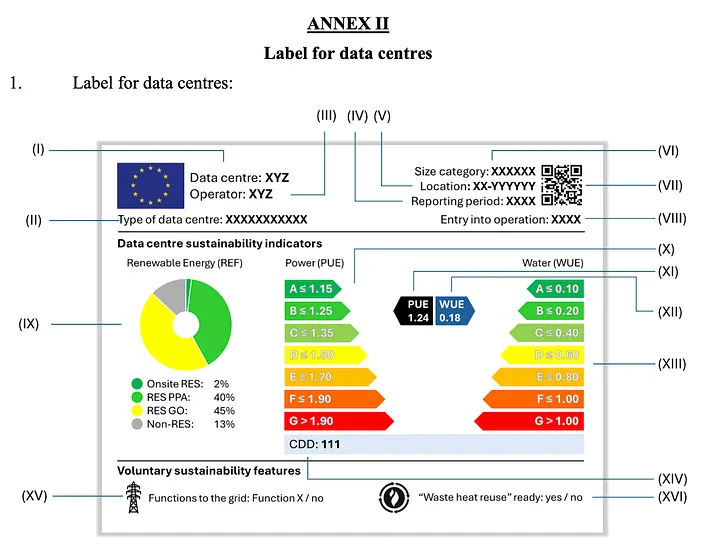
Annexes to the delegated Act supplementing Directive (EU) 2023/1791 of the European Parliament and of the Council and amending Commission Delegated Regulation (EU) 2024/1364 as regards the establishment of a common Union rating scheme for data centres, Annex II
The first limitation is obvious: while the methodology behind the grades will be publicly available, the underlying consumption figures remain strictly confidential under Article 5. So if a facility receives a WUE grade of C, anyone can look up what range of water consumption per kilowatt-hour that corresponds to. But what we won’t know is how many cubic metres of water that specific facility actually used.
There are also questions about the reliability of the grades. The classes are calculated from data that operators report themselves. The draft regulation proposes that national authorities can verify the quality of those reports, but the extent to which they are supposed to do so remains unspecified. The rating scheme depends on a verification system whose functioning is, at best, unclear.
Questions about access to the labels themselves remain open. Article 3 of the draft regulation (2026) stipulates that “labels for data centres shall be publicly available in electronic form in the European database (…)”, and Article 2 mentions a “publicly accessible space of the European database where this label is stored”. Article 4 requires operators to make their label available to “anyone who requests it”, either through their own website or the European database.
In theory, this introduces an active obligation for Member states and a reactive one for operators. But the formulation introduces a series of ambiguities: the draft regulation fails to clarify how the labels will be made accessible via the database. Will this information be searchable by location and companies, or only accessible for users who have access to the correct URL? Mentions of the database in the Delegated Regulation so far have focused on the aggregated presentation of the data. The draft also stops short of requiring operators to proactively publish the labels, giving them instead the option of using the database, in which case the question of data accessibility on said database becomes all the more important.
Finally, continued industry pressure could influence the final form of the labels, potentially reducing the information that will eventually be publicly available. Feedback submitted by industry stakeholders through the consultation include suggestions to not publish labels based on projected consumption for centers in the design stage and propose an exemption from the publication of information that could pose a “security threat”.
Where this leaves civil society
There is a significant transparency gap when it comes to data centers’ environmental footprints, and it is the result of a set of deliberate legal choices about who gets to see what was reported.
Those choices are being contested. Ten legal scholars told Investigate Europe that Article 5 of the EU Delegated Regulation “could violate” the Aarhus Convention, an international treaty that grants the public a right of access to environmental information. No legal challenge to Article 5 on Aarhus grounds has yet been litigated, but the legal ground is not settled.
What researchers and civil society need is facility-level environmental footprint data that is publicly searchable and broken down in a way that allows genuine monitoring of operators’ claims.
Sufficient granularity going beyond a benchmark is necessary, for example, to differentiate between the use of potable water and water from other sources or whether centers use renewable energy sources versus fossil fuels. The distinction between AI and non-AI workloads in the data is essential to be able to assess the environmental impact of AI workloads in particular.
Without access to granular, facility-level data, it is impossible to independently verify operators’ sustainability claims, assess the cumulative impact of data center expansion on local water and energy systems, or hold companies accountable for the commitments they make. Transparency, in this case, is not a superfluous demand: it is a practical prerequisite for designing sound policy, allocating shared resources fairly, and ensuring that the environmental cost of the data center boom does not remain invisible to the communities bearing it.
Are you a civil society organization interested or working on this topic? Get in touch with Auréliane, our program manager, at aureliane@wikirate.org